
Kishan P
June 12, 2026
Are you confused about which SaaS development technologies to choose for your next big project? This is a challenging task. Major issues often stem from early decisions made without enough foresight.
Thinking–what exactly makes up a SaaS tech stack? It’s the combination of frameworks, programming languages, databases, and powerful tools. Do you think–it’s just a technical choice? In reality, it influences everything, from user experience to operational efficiency. Their impact is clear. The best tech stack for SaaS empowers teams to build faster, cutting costs and ensuring futuristic growth.
Why does this decision matter more today? Because the stakes are rising. User expectations are higher due to complex SaaS application development. Recent 2026 reports make it clear. According to B2B Metrics, nearly 85% of SaaS products were using this technology–Kubernetes. Wondering why IT leaders choose them? It’s because they ensure autoscaling and reduce backend latency by 22% on average.
Now you might think–which technology will suit all my project needs? From detailing the key factors to defining the step-by-step in choosing the right tech stack, this blog details everything. By the end, you’ll know how to pick the technology for your business needs.
What Is a SaaS Tech Stack?
Before looking at the technologies, it’s essential to answer this simple question. What is the SaaS tech stack meaning? It refers to the collection of technologies that present in a modern SaaS application structure. That includes:
- React creates interactive user interfaces.
- Node.js handles server-side operations.
- MongoDB helps store and manage data.
When combined, these technologies work seamlessly. And they deliver fast, scalable experiences to meet your growing user base.
Key Factors to Consider When Choosing a SaaS Tech Stack
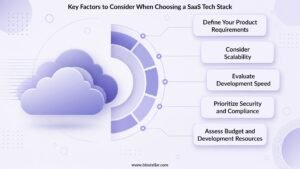
SaaS technology selection isn’t that easy. It directly affects your application’s performance and long-term costs. So, it must be selected carefully. Take a look at the key factors to consider while choosing them:
1. Define Your Product Requirements
Thinking–how to choose a SaaS tech stack that your business can thrive on. Then, start by defining your product requirements.
Ask:
- What core features do my users need most?
- Does my product require AI, automation, or ML?
- Which third-party integrations do I need? Think about your payment systems, CRMs, and analytics.
- What are my future requirements?
Answering these questions early makes your SaaS development process smoother. There is another reason. It ensures your product can grow without hitting roadblocks and keeps your business goals on track.
2. Consider Scalability
Scalability is one of the most important aspects of SaaS technology stack selection. Your customer base rises over time. That’s where you need an application that can handle increased traffic and larger datasets.
When evaluating scalability, consider:
- Expected user growth over the next few years.
- Data storage and database requirements.
- Performance during peak traffic periods.
- Cloud infrastructure.
- Load-balancing capabilities.
Building scalable SaaS applications from the beginning is a smart move. It supports continuous growth.
3. Evaluate Development Speed
People often go with products that come to the market first. That’s where development speed plays a crucial role. While SaaS technology stack, go with mature frameworks. They can significantly improve productivity and reduce development risks.
Look for:
- Frameworks with extensive documentation.
- Active developer communities for faster problem-solving.
- Rich libraries and tools that simplify development.
- Technologies that support faster deployment and maintenance.
Select proven technologies. This helps teams deliver products more quickly within their defined budget.
4. Prioritize Security and Compliance
This should never be an afterthought. If it’s weak, it can expose sensitive customer data that can damage your reputation.
Key areas to evaluate:
- Data encryption.
- Compliance standards (GDPR, HIPAA, or SOC 2).
- Regular updates.
Address security and compliance requirements early. This helps avoid expensive changes later in the development lifecycle.
5. Assess Budget and Development Resources
Working with a defined ratio is one of the SaaS development best practices. Some technologies look cheap at first. But over time, they can drive up maintenance costs and increase infrastructure bills.
So, how do you avoid that trap? Start by asking:
- What are the initial development and infrastructure expenses?
- Are skilled developers for this stack easy to find in the market?
- Will my team need extra training or new hires?
- What will long-term maintenance, updates, and support cost?
Plan ahead. A well-chosen tech stack ensures better returns on investment.
Choosing the Right Technologies for Your SaaS Application
The tools you select influence every outcome. It determines how quickly you can build, how easily your application scales, and how efficiently you manage long-term costs. SO, don’t just chase trends. Instead, focus on your product requirements, complexity, and growth plans. Let’s see the best technologies for SaaS applications:
1. Frontend Technology Selection
The front end matters more. It’s the layer that redefines how users communicate with your application. The choice isn’t random. It should align with the complexity of your project.
React:
- Extensive community support and third-party libraries.
- Includes reusable components.
- Excellent performance with virtual DOM.
- Easy to find skilled developers.
Angular:
- Easy to design with built-in tools.
- Strong architecture.
- TypeScript support improves code quality.
- Ensures long-term stability.
Vue.js:
- Simple learning curve.
- Lightweight framework with excellent performance.
- Flexible enough for all apps.
- Helps startups reduce development time and costs.
2. Backend Technology Selection
The backend SaaS technology stack powers business logic. Moreover, it supports APIs and data processing. Choose them based on the type of your product and its level of complexity.
Node.js:
- Handles multiple requests efficiently with asynchronous processing.
- Enables faster development using JavaScript.
- Excellent for real-time features and microservices.
- Supported by a large ecosystem of packages.
Python:
- Rich ecosystem.
- Faster development with clean and readable syntax.
- Strong community support.
- Ideal for innovative SaaS projects.
.NET:
- High performance and robust security features.
- Supports large applications.
- Smooth integration with Microsoft products and Azure.
Java:
- Proven reliability.
- Supports mission-critical applications.
- Highly scalable.
- Extensive ecosystem and enterprise support.
3. Database Selection
A database is for storing and managing application data. Choose based on your data structure and application use cases.
SQL Databases
SQL databases are suitable for applications that manage highly structured information. Ensure strong consistency and solve complex queries.
PostgreSQL
- Supports complex queries and advanced data types.
- Highly reliable and scalable.
- Assists analytics and transactional workloads.
- Open-source with an active community.
MySQL
- Easy to manage and widely supported.
- Reliable performance.
- Cost-effective.
- Highly compatible.
NoSQL Databases
With greater flexibility, it can handle large volumes of unstructured data.
MongoDB
- Flexible schema markup.
- Supports horizontal scaling.
- Well-suited for modern cloud-native architectures.
4. Cloud Infrastructure Selection
Cloud-based SaaS development is essential to keep up with the growing digital trends. That’s where you need the right cloud provider.
AWS (Amazon Web Services)
- Extensive cloud services.
- Scalable systems.
- Global infrastructure for better availability.
- Supports high-end automation.
Microsoft Azure
- Seamless integration.
- Strong security.
- Suitable for hybrid cloud environments.
- Meets policy adherence.
Google Cloud Platform (GCP)
- Advanced AI and ML features.
- Powerful analytics tools.
- Strong support for containerized applications.
- Competitive pricing.
Technology Comparison Table
| Component | Technology | Best For |
|---|---|---|
| Frontend | React | Dynamic and scalable applications. |
| Frontend | Angular | Enterprise applications. |
| Frontend | Vue.js | Startups and MVPs. |
| Backend | Node.js | Real-time applications and APIs. |
| Backend | Python | AI-based applications. |
| Backend | .NET | Enterprise-level platforms. |
| Backend | Java | Large-scale projects. |
| Database | PostgreSQL | Complex and analytical workloads. |
| Database | MySQL | Traditional web applications. |
| Database | MongoDB | Flexible and high-volume data. |
| Cloud | AWS | Highly scalable applications. |
| Cloud | Azure | Microsoft-based enterprises. |
| Cloud | Google Cloud | AI and analytics workloads. |
Common Mistakes to Avoid When Choosing a SaaS Tech Stack
Even strong SaaS products struggle. It happens when they choose the wrong technologies that slowly hinder them. So, it’s important to avoid these pitfalls. Look at the common SaaS development mistakes:
1. Choosing Technologies Based on Popularity
Trendy frameworks aren’t always the right fit. These SaaS tech stack mistakes often bring costly issues in later phases. So, choose wisely. Go with the stack that perfectly suits your team skills, budget, and integration goals.
2. Ignoring Future Scalability
A stack that works for 100 users may fail at 10,000. These are SaaS architecture mistakes. They arise when you neglect scalability, creating silos and bringing the need for expensive rework. So, plan for your future growth early. This ensures smooth expansion and reliable performance.
3. Overengineering Early-Stage Products
Startups often add complexity before proving product-market fit. So, choose lean architectures. They help launch faster and adapt easily with real user feedback. Remember, unnecessary tech slows development and drains resources.
4. Overlooking Maintenance Costs
Initial savings can hide long-term expenses. Licensing, updates, and specialized talent drive up costs over time. That’s where you need to evaluate the total ownership. This ensures better ROI.
Read Also: From Idea to Scale: How to Build a Successful SaaS Product
Conclusion
You should rely on trends for selecting the right SaaS tech stack. It must be around your product vision. Choose based on the stack’s core features and your unique user needs. Ensure they can grow with your traffic and demand. Evaluate for compliance and strong security to protect user data. It’s also essential to consider their development speed. This helps teams build and iterate quickly. The final step is to ensure that the chosen technologies are both cost-effective and under your budget.
There are no shortcuts. In SaaS application development, every project works differently. So, just stick to your plans. A thoughtful choice today brings lasting success in later phases.
Ready to build a high-performing SaaS application? Then, choose Binstellar as your development partner. We help businesses choose the right SaaS tech stack after analyzing their business objectives. Contact us today! Let’s turn your simple SaaS vision into the best product.
FAQs
1. How do I know which tech stack my SaaS idea needs?
Early MVPs prefer simple stacks for speed. But enterprise SaaS requires advanced technologies for scalability and complex features. So, choose the tech stack after evaluating the complexity and product stage.
2. Should I choose a tech stack first or finalize my SaaS features first?
Always define product features first. Features guide technology choices, ensuring the stack supports functionality, scalability, and user needs. Choosing tech before features risks misalignment and wasted resources.
3. Is it possible to modify the technology stack as my SaaS product scales?
Yes. But this procedure is costly as it requires rearchitecture and downtime. That’s where to plan at scale. This avoids disruptive changes and ensures smoother long-term growth.
4. How much does the tech stack really impact development cost?
The stack directly affects costs. Licensing, developer availability, and maintenance all add up. Smart choices reduce expenses. Meanwhile, poor ones increase long-term financial burdens.
5. What is the major mistake startups make while picking their tech stack?
Overengineering too early. Startups often add unnecessary complexity before validating product-market fit. A lean stack accelerates launch, reduces costs, and allows growth-driven adjustments later.
Written by
Kishan P