
Kishan P
June 8, 2026
Corporate training is a winning business strategy. It’s because technologies grow and skill requirements change. This is where structured training matters. From onboarding new employees to technical upskilling, effective programs shape a productive, future‑ready workforce.
But here’s the challenge. As training needs expand across departments, traditional learning methods often struggle to keep pace. Organizations need a way to manage them all. This growing challenge has accelerated the adoption of corporate training LMS solutions. The 2026 report by LMS Guide clearly states this. The corporate LMS market is projected to grow at a CAGR of 19.1%, highlighting its need in the workplace.
Now you might get confused–how to meet these evolving demands? That’s where businesses are looking for flexible and cost-effective learning platforms. Enter the role of Moodle for corporate training. It helps companies create tailored experiences that perfectly match their project needs. Also, it offers huge functionalities. Thus, companies gain greater control over their training environment and budget.
Want to learn more about Moodle LMS for business training? Then read this blog. Here, we’ll detail everything from what it is and its benefits to the key reasons companies prefer it. Moreover, we’ll state how it differs from other LMS platforms.
Understanding Moodle: What It Is and How It Works
Moodle is designed to create, deliver, and manage digital learning experiences. It was initially developed for educational institutions. But the Moodle learning management system is best for organizations seeking scalable learning environments.
At its core, Moodle functions as a centralised corporate e-learning system. It lets administrators create tailored courses. Moreover, it helps them assign learning paths, conduct assessments, and track learner progress. This makes studying more accessible and convenient. The platform also supports interactive features such as quizzes.
Thinking–who are its key users? Today, Moodle serves a diverse range of visitors, including enterprises, universities, and training providers. It is an adaptable employee training software. This flexibility has made it a trusted and scalable learning ecosystem.
Why Corporate Training Needs a Strong LMS?
Before jumping into an LMS, you must know why outdated methods fail. They follow classroom-based sessions. Furthermore, their manual record-keeping can lead to inconsistent learning experiences.
That’s where corporate training LMS enters the game. It offers a centralized environment that manages all learning activities, content, and employee records. This eliminates administrative inefficiencies. And it ensures that employees receive up-to-date training.
Now, how to monitor performance and progress? Modern employee training software enables companies to track everything, from course completion to skill development, in real time. These insights are valuable assets. They help managers identify knowledge gaps and measure their effectiveness.
Think–why do we need remote and hybrid workforces? With distributed teams becoming the norm, businesses also need an online corporate training platform. It supports learning beyond physical offices. And it ensures that employees can access training anytime, anywhere.
Key Reasons Companies Prefer Moodle
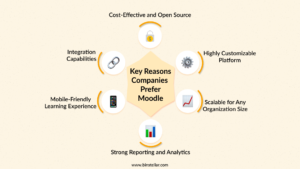
From affordable and mobile-friendly experiences to advanced integrations, Moodle supports diverse training requirements. Let’s explore them in detail:
1. Cost-Effective and Open Source
No licensing fees
As an open-source LMS for companies, Moodle eliminates the expensive licensing fees. Thus, companies can cut recurring software costs. And they can invest more in content development, employee engagement, and training strategy.
Custom development flexibility
The open-source architecture offers complete control over their learning environment. Companies can work freely without restrictions. They can modify features, workflows, and user experiences based on their specific requirements.
Lower maintenance cost
LMS lets companies customise their platforms as needed. This helps them reduce long-term expenses and avoid unwanted feature costs. These Moodle LMS benefits make it a sustainable solution.
2. Highly Customizable Platform
Custom dashboards and branding
Learning objectives often differ. Moodle lets companies create tailored dashboards rather than forcing them to adapt to a rigid system. It also helps them develop branded interfaces. By reflecting their brand identity, this approach engages users better.
Plugin ecosystem
Moodle also offers extensive add-ons. Moodle plugin development enables companies to add additional capabilities. It supports their training needs.
Tailored learning paths
With Moodle, businesses can build role-specific journeys. These customized learning paths drive true results. It ensures that employees receive relevant training based on their career progression goals.
3. Scalable for Any Organization Size
Suitable for startups to large enterprises
Companies grow over time. So their learning platform should support increasing numbers of users. Moodle makes it possible. It is designed to accommodate businesses of all sizes, making it the best scalable LMS solution.
Supports thousands of users simultaneously
Large enterprises benefit from Moodle’s ability to manage thousands of learners simultaneously. It also maintains a consistent learning experience. As a comprehensive corporate e-learning platform, Moodle supports complex structures. It also enables multiple user roles. This makes it suitable for enterprise-wide learning initiatives.
4. Strong Reporting and Analytics
Employee progress tracking
Moodle provides robust reporting and analytics capabilities. This brings effective training results. Managers and administrators can now track employee progress in real time.
Completion rates and performance insights
The platform also provides detailed completion reports. They also provide performance analytics. These metrics allow businesses to measure learning outcomes. It also helps evaluate their impact.
Data-driven training decisions
Data-backed insights fuel growth. They help companies make informed decisions about future learning initiatives. It also helps them continuously improve workforce development strategies. These reporting capabilities make it the best LMS for corporate training environments available today.
5. Mobile-Friendly Learning Experience
Mobile app support
Modern employees expect responsive experiences. So that it fits their work schedules and daily routines. Moodle deliver a mobile-friendly learning experience that makes training accessible everywhere. This flexibility improves engagement. And it encourages continuous learning beyond traditional office environments.
Anytime, anywhere learning
Moodle serves as an effective remote employee training platform that supports workforce development regardless of location. The platform also functions as one of the most practical hybrid workforce training tools. This ensures consistent learning experiences.
6. Integration Capabilities
HR systems integration
Corporate learning platforms rarely operate in isolation. Businesses often need their LMS to connect with HR systems and other enterprise applications. Moodle supports this. It offers extensive integration capabilities that help organizations create a unified digital learning ecosystem. This reduces HR workloads. And it ensures that learning records remain accurate and up to date.
CRM and third-party tools support
Moodle offers advanced integration. This includes CRMs, productivity tools, and various third-party applications. These connections improve workflow efficiency. Through advanced Moodle plugin development, companies can extend platform functionality. It also lets them connect virtually with any enterprise system.
API-based extensibility
Its API-based architecture further enhances extensibility. And it allows businesses to develop custom workflows and highly connected learning environments that support long-term growth.
Moodle vs Other Corporate LMS Platforms
Going to invest in any learning solution? Then, you must understand the differences between Moodle vs other LMS platforms. Here’s what they do:
Moodle vs Proprietary LMS Tools
Proprietary LMS platforms are generally offered through subscription-based licensing models. They often provide ready-to-use features. But companies may face recurring licensing fees and restrictions on platform modifications. Moodle takes a different approach. As an open-source LMS for companies, it provides access to the source code. Thus, businesses can manage it easily.
Another key distinction lies in feature expansion. Many proprietary platforms charge additional fees for functionalities. But Moodle gives access to more add-ons. It enables companies to enhance capabilities without expensive upgrade paths.
Flexibility and Ownership Advantages
Their key benefits include:
- Full control over learner data and training records.
- Custom development.
- Greater flexibility in hosting and infrastructure decisions.
- Reduced dependencies.
- Easier adaptation to changing business requirements.
Through advanced Moodle features for enterprises, companies can create highly personalized learning ecosystems. Proprietary LMS environments aren’t this flexible.
When Moodle Is a Better Choice
Choose Moodle when you:
- Need a cost-effective solution.
- Require extensive customization.
- Want complete ownership.
- Need specialized workflows.
- Plan to scale training programs.
- Require advanced integrations.
- Prefer long-term flexibility.
Overall, the decision varies. Choose Moodle customization services that works with your long-term goals.
Conclusion
Moodle is now the most reliable solution for corporate learning. It is not like other proprietary platforms. Instead, it allows businesses to build training environments that align with their operational goals and workforce needs.
Flexibility is its huge strength. Moodle features for enterprises help them deliver structured and measurable training programs at scale. In addition, they are highly customizable. Moodle can be adapted to support a wide range of corporate training objectives and business processes.
As a scalable LMS solution, Moodle supports future growth as well. It is highly customizable. This makes it a compelling choice for companies looking to build true results.
Ready to transform your corporate training strategy? Then choose Binstellar as your Moodle development partner. With top-notch custom Moodle development services, we make learning enjoyable. Our experts simplify the process. They’ll help you streamline employee development and maximize training outcomes. Contact us today! Let’s help you create successful corporate training platforms that thrive.
Written by
Kishan P