
Kishan P
May 29, 2026
Have you ever thought–why do some online stores turn visitors into loyal customers while others struggle to generate sales even after driving massive traffic? The answer often lies in the shopping experience.
Modern customers no longer engage with traditional online stores. They find them slow, outdated, or difficult to navigate. That’s exactly where custom Shopify store development comes into play. They are engineered around your technical and project needs. They don’t rely on generic themes. Instead of generic experiences, they ensure seamless browsing , personalized experiences, and a simple checkout process.
This shift in behaviour says conversion rate is one of the most critical factors influencing online business success. But driving traffic isn’t just enough. Your Shopify store must convince them to stay long without friction. Enter the role of structured Shopify website development. It improves engagement with its unique features.
Thinking–why choose Shopify? It’s because of its flexibility. They have an extensive app ecosystem and enterprise-grade capabilities. From custom storefront development to third-party integrations, Shopify store development services combine it all into a unified ecosystem. Thus, they can adapt to different business requirements.
In this blog, let’s see how to build a Shopify store from scratch. By the end, you’ll get the right strategies that deliver sustainable growth.
Step-by-Step Guide to Build a High-Converting Custom Shopify Store
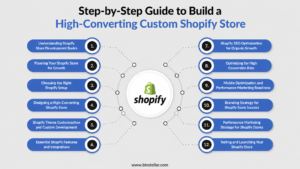
A high-converting Shopify store is not built by chance. It is created through the right strategy and scalable development practices. So, it is essential to understand each stage of the Shopify development process. Let’s see them in detail:
Step 1: Understanding Shopify Store Development Basics
Shopify store setup often starts with strategic planning.
But before planning, you must understand these basics:
- Know your target audience and their purchase intent.
- Define product positioning and the niche you choose.
- Learn Shopify architecture and its storefront structure.
- Analyze the current plans to find the right one.
- Figure out their features like mobile responsiveness, performance, and tracking.
Have these insights in mind. And then start to create a well-planned Shopify store builder guide. This approach improves the conversion performance.
Step 2: Planning Your Shopify Store for Growth
This is the important stage in custom Shopify development services. Many businesses focus only on design. But without a proper roadmap, scaling the store later becomes difficult. A growth-focused strategy resolves these issues. It improves Shopify’s conversion rate and helps them perform consistently.
Follow this planning checklist:
- Create a scalable product and collection hierarchy.
- Plan future app integrations and automation workflows.
- Ensure multi-device shopping experiences.
- Set up analytics and tracking systems early.
- Build a structure that supports future SEO.
- Assist with the marketing campaigns.
Step 3: Choosing the Right Shopify Setup
The success of your shop depends on the framework. This means a one-size-fits-all Shopify store setup rarely works. So, your configuration must support current and future requirements.
Here’s how to choose:
- Pick the right Shopify plan.
- Select a lightweight theme.
- Check app compatibility and integration flexibility.
- Configure checkout options.
- Prepare for global selling.
- Make sure it’s scalable to meet changing needs.
Step 4: Designing a High-Converting Shopify Store (CRO + UX Focus)
Today, visually appealing design alone does not drive conversions. This is where Shopify UX design plays a critical role. With behavior insights and clear interface structures, it guides visitors smoothly.
Important CRO and UX elements include:
- Creating clear navigation and product discovery paths.
- Designing mobile-friendly layouts with fast interactions.
- Using strong CTAs and simplified product pages.
- Reducing checkout distractions and unnecessary steps.
- Building trust through reviews, badges, and social proof.
- Optimizing page hierarchy.
Engagement comes first. Shopify UX optimization for e-commerce is about effortless shopping experience. That’s how it turns browsing into buying.
Step 5: Shopify Theme Customization and Custom Development
Your store theme shapes your website performance, flexibility, user interaction, and conversion efficiency. Standard themes may launch fast. But modern e-commerce brands need advanced Shopify theme customization so that they can support unique journeys, dynamic content, and scalable features.
Here’s what to look for in customisation:
- Personalize Shopify Liquid templates and dynamic sections.
- Optimize theme code for faster loading performance.
- Create conversion-focused product and collection layouts.
- Implement advanced filtering, search, and recommendation features.
- Enhance mobile interactions and responsive design behaviour.
- Integrate APIs and custom functionalities without performance overload.
Step 6: Essential Shopify Features and Integrations
Modern brands require a connected ecosystem. This is why feature selection and integration planning are critical stages in e-commerce website development. The right integrations improve operational visibility. It cuts down the manual grind. And in doing so, it creates smoother, more delightful customer experiences.
To make this real, your roadmap should highlight:
- AI-powered recommendations that feel personal.
- Advanced search, filtering, and predictive systems.
- CRM tools that boost retention.
- Digital wallet and one-click checkout options.
- Conversion tracking tools.
Step 7: Shopify SEO Optimization for Organic Growth
Modern search engines expect more. From semantic relevance to Core Web Vitals and structured data, they prioritize so many features. This is where Shopify SEO optimization becomes essential for growth. It improves crawlability, indexing efficiency, and discoverability throughout the journey.
Here’s how to optimize:
- Create clean URL structures with keyword-focused metadata.
- Optimize storefront speed for instant loading.
- Implement schema markups to boost visibility.
- Build an SEO-friendly collection with strong internal linking.
- Compress product images.
- Add descriptive alt text for better crawlability.
- Publish intent-driven content and ensure mobile-first indexing compatibility.
Step 8: Optimizing for High Conversion Rate (CRO Strategy)
Traffic alone does not guarantee revenue. This is where you need Shopify conversion rate optimization. Modern CRO strategies are data-driven. They use heatmaps and funnel analysis to understand customer intent. This increases purchase completion rates.
Here’s how to optimize:
- Simplify checkout flows and minimize unnecessary form fields.
- Use sticky CTAs.
- Add urgency triggers like limited stock and time-sensitive offers.
- Personalize recommendations.
- Run A/B tests on checkout elements to identify where users drop off.
- Implement one-click payment methods.
- Enhance product pages with trust indicators.
Step 9: Mobile Optimization and Performance Marketing Readiness
Smartphones dominate storefront traffic today. According to 2026 Shopify reports, around 74–79% of shoppers use mobile devices. Ignoring this shift means leaving conversions on the table. At the same time, performance marketing campaigns also create measurable impact.
To optimize your Shopify store:
- Streamline layouts to adapt faster.
- Boost site speed by trimming code and using lazy loading techniques.
- Minimize JavaScript bloat.
- Design intuitive navigation that works naturally with touch gestures.
- Implement server-side tracking.
- Offer fast checkout flows to maximize completion.
Step 10: Branding Strategy for Shopify Store Success
Today’s shoppers go with branded products. So, your business must deliver trust and good experiences that keeps them come back. If not, you fall short of your competitors. So, it’s best to hire Shopify developers who can give you complete assistance.
Check these core ideas:
- Define clear value propositions.
- Bring a unique brand voice.
- Ensure visual harmony across every customer touchpoint.
- Use branded packaging.
- Trigger emotional customer connection with storytelling techniques.
- Ensure consistent results across all devices.
Step 11: Performance Marketing Strategy for Shopify Stores
Customers today don’t buy only what you sell. Instead, they get with products that feel personal and built for them. That’s where performance marketing steps in. It turns every click into proof and every number into a story of scale.
Here’s a strong strategy:
- Configure GA4 for accurate data capture.
- Build segmented audiences.
- Launch campaign-specific landing pages.
- Implement AI-driven bidding.
- Track funnel drop-offs to reduce unwanted expenses.
- Do A/B testing across ads and CTAs.
- Automate email and product feed for high-value segment targeting.
Step 12: Testing and Launching Your Shopify Store
Launch day matters. Sometimes, top Shopify builds also fear losing their conversions. That’s why pre‑launch validation is your shield. It ensures stability, speed, and security before real customers arrive.
Your launch checklist:
- Make sure product pages and checkout flows feel error-free.
- Test mobile responsiveness.
- Audit page load times so customers never wait.
- Verify that your analytical details are correct.
- Enable strong security settings.
Conclusion
A store should convert. Building a high‑performing Shopify storefront takes a clear growth plan. From SEO to CRO tactics, all play their part. And they demand strategic planning, scalable development, and performance-driven marketing. Custom Shopify store development makes this possible. It helps businesses create seamless shopping experiences that improve conversions gradually.
Ready to build a conversion-focused store? Then partner with a leading Shopify development company in india like Binstellar. From UI/UX design to SEO, our experts take care of all the development steps. Contact us today! Let’s launch a store built for long-term success.
Written by
Kishan P