
Kishan P
September 28, 2026
E-commerce stores have to keep up with changing customer expectations. Enter the role of headless Shopify development. With this approach, developers separate the storefront from Shopify’s commerce backend. This gives them more freedom to build the customer-facing side. Shopify continues to manage the core ecommerce functions in the background.
But is headless Shopify worth the added development work? That depends on what the store actually needs. This guide covers how headless Shopify works, its benefits, development costs, common mistakes, and the situations where going headless may be worth considering.
What Is Headless Shopify?
Headless Shopify splits the storefront from the backend. Here, Shopify continues to manage products, payments, and other core commerce functions. Meanwhile, the frontend handles what customers see and use.
This headless Shopify architecture gives businesses more freedom. It helps them build a customized shopping experience while keeping Shopify’s existing commerce infrastructure.
Why Are Businesses Moving Toward Headless Shopify?
Businesses often look at headless commerce when their current setup cannot keep up with their growing requirements. Take a look at why:
Performance Requirements
Complex stores can get heavy quickly. Large product catalogues, third-party tools, and detailed shopping journeys can all add more work for the storefront to handle. Performance can suffer. With a separate frontend, developers have greater control over page structure, rendering, assets, and other technical details that affect how the store loads and feels to customers.
Custom Customer Experiences
Standard themes have their limits. Some businesses need specialised product discovery, personalised shopping journeys, interactive interfaces, or purchasing flows that do not fit neatly into an existing theme. That can become restrictive. With headless development, teams can shape these experiences around the business instead of forcing every requirement into a predefined theme structure.
Scalability
E-commerce needs can change as businesses grow. New products and digital touchpoints may become part of the overall customer experience. Growth brings new requirements. A decoupled frontend gives development teams more room to expand the storefront without having to rebuild the underlying commerce system.
Multi-Channel Commerce
Customers use different digital channels. They may visit a website, use a mobile app, or interact with a kiosk. One backend can connect them. Headless architecture lets these different interfaces access Shopify’s central commerce capabilities through APIs, making it easier to manage core operations while creating experiences suited to each channel.
Key Benefits of Headless Shopify Development
When headless Shopify aligns with a business’s needs, it can provide several practical benefits. Take a look at them:
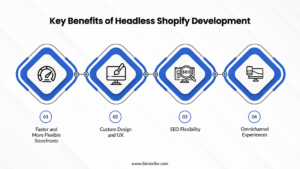
Faster and More Flexible Storefronts
Developers get more control with a separate frontend. They can decide how pages are structured, rendered, and delivered, making it easier to optimize the storefront around specific project needs. That adds flexibility. Shopify headless development also lets teams create different frontend experiences while keeping Shopify’s core commerce functionality unchanged.
Custom Design and UX
Themes can feel restrictive sometimes. Headless development gives businesses more freedom to shape layouts, navigation, product displays, and interactions around their brand and customer journeys. That opens up options. This approach can be especially useful when a store needs specialised buying experiences that a conventional theme cannot easily support.
SEO Flexibility
SEO needs attention from the start. Page structure, metadata, internal links, rendering, canonicalisation, and content accessibility all need to be handled carefully during development. Planning matters here. A headless frontend gives developers more control over these areas, but SEO requirements should be built into the project rather than treated as something to fix after launch.
Omnichannel Experiences
One commerce setup can serve many channels. Headless Shopify lets businesses connect websites, mobile apps, and other customer-facing interfaces to the same commerce foundation. This keeps things connected. Core commerce operations can remain centralised while each digital channel offers an experience designed for its own users.
Headless Shopify vs Traditional Shopify
A traditional Shopify store can work well for simpler needs. But Headless is different. It becomes more useful when a business needs a highly tailored experience. Here’s how they compare.
| Factor | Traditional Shopify | Headless Shopify |
|---|---|---|
| Architecture | Storefront and commerce functionality are more closely integrated. | Frontend and backend are separated. But they are connected through APIs. |
| Flexibility | Uses all features within a structured framework. | Provides greater control over design and functionality. |
| Performance | Depends on theme quality, apps, and implementation. | Gives developers more control over performance. |
| Development & Maintenance | Generally simpler to build and maintain. | Requires separate frontend and maintenance work. |
| Cost | Often more accessible for straightforward ecommerce stores. | Usually requires a higher investment because of additional development work. |
| Best Use Cases | Suitable for conventional stores with standard needs. | Best choice for complex and customized requirements. |
Headless Shopify Development Cost
There is no fixed price for headless Shopify projects. This is because every implementation has a different scope. An indicative development range is $15,000 to $100,000 and more.
Key Cost Factors
Several elements can influence headless Shopify cost, including:
- Front-end complexity.
- UI/UX design.
- Complex integrations like CRMs and analytics.
- Intricate data exchanges.
- Migration work.
- Comprehensive testing.
Integration and Migration Costs
Migration costs more. It’s because, from existing integrations to third-party apps, all need to be reviewed before the move. Planning helps avoid problems. A structured headless Shopify migration allows teams to identify these dependencies early. This makes the transition hassle-free.
Ongoing Maintenance
Headless stores need ongoing attention. Frontend updates, API connections, integrations, performance improvements, testing, and compatibility changes may all require regular work over time. These costs can add up. Businesses should include these recurring requirements when calculating the overall cost of owning a headless Shopify store.
Why Can Headless Cost More Than Traditional Shopify?
Headless Shopify requires more development work. Teams have to build a separate frontend, connect it with Shopify, manage integrations, and test how everything works together. That adds to the cost. The extra investment should be weighed against the specific features, flexibility, and business requirements the architecture needs to support.
Read Also: How to Build a High Converting Custom Shopify Store from Scratch?
Common Mistakes in Headless Shopify Development
Headless commerce provides greater control. Poor preparation can lead to avoidable complexity during development. Let’s take a glance at these faults:
Over-Engineering
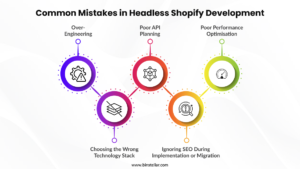
Keep the setup practical. Adding custom features without a clear reason can increase development time and make future maintenance harder. More complexity is not always better. The architecture should match what the business actually needs.
Choosing the Wrong Technology Stack
The frontend technology should suit the project’s performance needs, integrations, development skills, and maintenance plans. Choosing a popular option without checking these requirements can create development issues and add maintenance work later.
Poor API Planning
APIs connect the storefront with Shopify. Poor data planning can lead to integration issues, unnecessary requests, and harder troubleshooting. Teams should map data flows early to keep API interactions and implementation smoother.
Ignoring SEO During Implementation or Migration
SEO needs to be planned early. URLs, redirects, metadata, internal links, canonical tags, and rendering should be considered during headless Shopify development services to avoid issues later.
Poor Performance Optimisation
Headless architecture does not guarantee faster pages. Large images, unnecessary scripts, and inefficient code can still slow stores, so teams should test and optimize performance throughout development.
Conclusion
Headless Shopify offers greater control. It gives businesses more freedom to shape storefront design, performance, and customer experiences around their needs. That flexibility comes with added work. Businesses need careful planning, a higher investment, and ongoing maintenance to manage their Shopify headless storefront properly. Their needs should come first. This helps determine whether headless Shopify fits the store’s requirements, resources, and future growth plans.
Ready to build a high-performing Headless store? Then, partner with a trusted Shopify development company in India like Binstellar. We offer custom Shopify development services that help businesses plan and build solutions tailored to their technical and business needs. Contact Us today! Let’s take the next step toward a more flexible Shopify store.
Written by
Kishan P