
Kishan P
August 31, 2026
There is no fixed price for building a SaaS app. It varies based on the functionality your product needs and its architectural complexity. That’s where you need to focus on the scope of your project. A lightweight MVP may require a modest investment, while advanced enterprise products can demand significantly larger budgets. Other than this, several factors shape the final cost. From features and integrations to security and scalability, all influence the budget roadmap. The development approach matters too. Your chosen methodology and team expertise can also affect the final estimate and project timeline. So, define your product first. Businesses planning custom SaaS development services should establish their product scope clearly before deciding on a suitable budget.
This guide breaks down the typical SaaS development cost structure in 2026. We’ll also detail the factors behind them. By the end, you’ll know how to plan an appropriate investment for your product.
How Much Does It Cost to Build a SaaS Product in 2026?
SaaS development costs in 2026 vary significantly. A project’s scope, technical complexity, and scalability needs determine them. A lean MVP may demand a modest budget. Meanwhile, enterprise-grade platforms with complex workflows, integrations and high scalability requirements need more investment.
| SaaS Product Type | Indicative Cost | Timeline |
|---|---|---|
| SaaS MVP | $15,000 to $50,000. | 2 to 4 months |
| Standard SaaS | $50,000 to $1,50,000. | 4 to 8 months |
| Advanced SaaS | $1,50,000 to $3,00,000. | 8 to 12 months |
| Enterprise SaaS | More than $3,00,000. | 12 to 18 months and more |
These figures are just approximate values. Thus, the actual estimates depend on the product scope, architecture, integrations, security requirements, and scalability targets. The development team’s location and expertise are also included.
For a deeper breakdown, see our guide on the cost of SaaS product development.
What Factors Affect SaaS Product Development Cost?
Several product decisions can shift SaaS development pricing. So, you need to understand them early to make your budget more realistic. 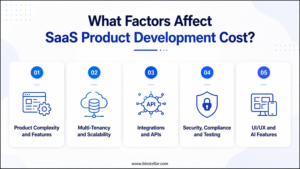
Product Complexity and Features
Features determine much of the development effort. A simple subscription platform with account management and basic reporting requires less work than a product with complex workflows, real-time functionality, advanced dashboards, and extensive administrative controls.
The number of user roles matters too. Each one may require different permissions, screens, and workflows. Business logic can add another layer of complexity. It affects most when the application needs automated processes and conditional rules.
Admin functionality should also be considered. From users and subscriptions to reports and configurations, all require dedicated interfaces and backend logic.
Multi-Tenancy and Scalability
SaaS products serve many customers through the same application. This makes multi-tenant architecture an important cost consideration from the beginning.
The system needs appropriate mechanisms for separating tenant data while allowing each customer to access only authorised resources. Permissions, account structures, tenant-specific configurations, and usage controls may all require additional development.
Scalability also affects architecture decisions. A platform designed for hundreds of users may need different infrastructure when it is expected to support thousands or millions. So, plan for your growth. Although this can increase the initial effort, it helps prevent costly architectural changes as the product expands.
Integrations and APIs
Integrations can raise development costs. This includes payment gateways, CRM platforms, email and SMS services. Even third-party APIs can expand both functionality and development requirements.
AI integrations can introduce additional considerations. Connecting an AI API may appear straightforward, but production use can require prompt management, data handling, usage controls, response validation, monitoring, and cost management.
The number and complexity of integrations therefore matter more than simply counting them.
Security, Compliance and Testing
Security needs attention from day one. Authentication, authorization, access controls, data protection, secure API communication, and security testing should be considered throughout development.
Compliance requirements can add further work where applicable. Depending on the product, businesses may need to address various requirements. GDPR, SOC 2, or HIPAA fall under this.
Testing also affects the budget. Functional testing validates application behaviour, while performance testing examines response times. But security testing is different. It can identify vulnerabilities before the product reaches customers.
UI/UX and AI Features
A SaaS product needs more than functional code. Its interface must help users complete tasks without unnecessary complexity. Custom dashboards, navigation structures, account screens, reporting interfaces, and responsive experiences all contribute to UI/UX effort.
AI can increase development scope further. AI-powered search, automated recommendations, and predictive analytics require more. They need additional logic to handle data. The cost therefore depends on how deeply AI is embedded into the product.
SaaS Development Cost at Different Product Stages
Cost usually rises as products mature. An MVP includes the essential features needed to validate the business idea with real users. Then, requirements expand. A standard product may add broader workflows, integrations, account management, and reporting capabilities as user needs grow.
Advanced platforms demand more. They may include automation, deeper integrations, security controls, and scalability requirements. Enterprise products go further still. They often require extensive customization, complex permissions, compliance measures, high availability, and integration with existing organizational systems. This staged approach offers flexibility. Businesses can invest according to product maturity instead of paying upfront.
Read Also: Why Every SaaS Product Needs AI Features to Stay Competitive?
How to Reduce SaaS Development Costs Without Sacrificing Quality?
Control costs through smarter scope management. Instead of cutting essential engineering work, start with a focused MVP. It solves one clearly defined customer problem. Prioritize must-have functionalities.
Use proven services where possible. It can reduce the effort and cost of building from scratch. However, select them properly. Consider pricing, reliability, integration effort, and future limitations while choosing.
Plan multi-tenancy and billing architecture early. Retrofitting these foundations can become expensive once the application has grown.
Phased development is another practical approach. Launch the product first, collect user feedback, then expand based on their demand. Experience can prevent unnecessary development. A professional team can spot avoidable custom work and suggest practical alternatives.
What Should You Look for in a SaaS Development Partner?
Look beyond the lowest quotation. Choose a partner based on technical capability, proven experience, and its ability to build scalable SaaS products. Experience matters here. A reliable SaaS development company should understand multi-tenant architecture and complex workflows. Check its technical strengths too. Review experience with APIs, third-party services, security engineering, performance optimisation, and AI-enabled functionality.
Good design matters equally. Strong UI/UX capabilities can make technically sound products easier for users to navigate and adopt. Do not overlook support. QA processes and post-launch services should cover testing, upgrades, and production issues. Monitoring and future enhancements must be part.
Ask for pricing clarity. When working with a SaaS platform development company, request an estimate with all details. This includes scope, milestones, and potential additional costs. This makes comparisons much easier. A transparent proposal gives you a clearer basis for evaluating different development partners.
Conclusion
Your early decisions shape the final investment. Defining priorities, anticipating technical demands, and deciding what to build first can make SaaS spending more predictable. A simple MVP with fewer features costs less. Meanwhile, if you’re planning a bigger project with customized functionalities costs much more.
Want to know the clear pricing structure of your SaaS build? Then, partner with a leading SaaS application development company like Binstellar. Our team first analyzes your project goals and technical needs. We then help you plan, design, develop, and refine your SaaS solutions. From initial planning through development and ongoing improvements, we take care of every step. Contact us today! Let’s find the right development approach for your business.
FAQs
Are there ongoing costs after launching a SaaS product?
Yes. SaaS products bring recurring expenses, including hosting and infrastructure. Security systems add to this, as it needs regular updates. Ongoing spending is required to maintain and meet the future needs.
Does adding AI increase the cost of a SaaS product?
Yes. AI can increase SaaS development costs through model integrations, data processing, and prompt engineering. Testing matters too. Monitoring, usage management, and additional infrastructure requirements can further increase the overall development investment.
Does SaaS development cost include UI/UX design and testing?
It depends on the project quotation. A detailed estimate should clearly outline what it covers. This should include whether UI/UX design, quality assurance, and security testing are part of the quoted cost.
Can I start a SaaS product with a limited budget and scale it later?
Yes. You can start with an MVP at low initial investment. You can expand it later based on your project and market requirements. So, plan ahead. Architecture, multi-tenancy, security, and billing decisions should still support the product’s expected future growth.
Written by
Kishan P