
Kishan P
May 18, 2026
SaaS in 2026 is no longer just a software delivery model.. It acts as the cornerstone of today’s business innovation. The global SaaS market is expected to exceed $375 billion this year. Do you know how? They started building scalable SaaS solutions that can meet growing demands.
Across industries, the impact is clear. Healthcare, retail, and beyond now rely on SaaS to run mission critical operations. It’s because automation and real-time experiences are non-negotiable here. Likewise, their priorities are also shifting. Businesses are moving beyond cost savings. They focus more on adaptability. And they are working with predictable revenue models. This ensures long-term sustainability.
That’s where structure matters. A well-defined SaaS product development lifecycle acts as a connectivity model. It bridges user expectations with business outcomes. Overall, the goal is simple. To turn ideas into scalable, future-ready platforms through a process that is both strategic and technically sound.
This blog breaks down the step-by-step SaaS development process. Let’s explore why it matters. By the end, you’ll know how it transforms simple ideas into future-ready platforms.
Why SaaS Product Development Matters More Than Ever in 2026?
SaaS drives resilience. Fueled by AI, vertical specialization, and edge-ready architectures, it drives growth at scale. Here’s why SaaS-based product development matters:
Powers Scalable and Adaptive Business Models
Agility defines success. Scalable SaaS solutions help businesses respond to changing user demands, pricing models, and expansion strategies without friction. That’s the advantage. With multi-tenant cloud-native systems and API-first architecture, it reduces friction. Thus, companies can launch, iterate, and scale smoothly.
Enables Recurring and Predictable Revenue Streams
Revenue becomes more stable in SaaS. Instead of a one-time transaction, it introduces subscription and usage-based models that drive consistent income over time. This makes it a smarter growth engine, giving businesses stronger financial visibility. Adopt a well planned SaaS product strategy. It sets pricing tiers designed to maximize customer lifetime value. Revenue can be predicted. And the system scales with confidence, giving businesses something they can truly rely on.
Delivers Solutions Anywhere, Anytime
Access is no longer optional. Users today expect fast, seamless experiences without compromise. SaaS makes that possible. Through modern SaaS application development, businesses can deliver high-availability platforms. These platforms perform reliably whether accessed locally or globally.
Supports AI-driven and Intelligent Systems
AI is now built-in. AI-powered SaaS platforms integrate real-time insights and adaptive user experiences. It helps them to learn. These systems continuously evolve using behavioural data, enabling faster and more informed decisions.
Improves Customer Acquisition and Retention Efficiency
Growth becomes more efficient. Built in analytics and personalization refine onboarding and cut acquisition costs. User journeys feel smoother. And the payoff is clear—stronger relationships and sustainable growth.
The Takeaway: SaaS redefines growth. It enables companies to scale faster and monetize smarter.
End-to-End SaaS Product Development Process
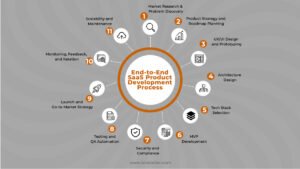
Wondering how to build a SaaS product? Developing software isn’t just a checklist. From discovery and validation to refinement, there are so many steps. Let’s explore them:
Step 1: Market Research & Problem Discovery
Start with clarity. Use AI-driven research and behavioural insights to identify potential problems. Don’t work on assumptions. Use predictive insights and generative personas that highlight gaps costing users time, money, or efficiency. The goal is simple. Address proven user pain points that have a real impact at a global scale.
Step 2: Product Strategy and Roadmap Planning
Direction matters. Translate your vision into execution through JTBD frameworks and dynamic roadmaps. Alignment is critical. So, ensure outcomes stay closely tied to real user needs and validated telemetry data. Finally, check that they adapt constantly. It’s because a strong SaaS product roadmap should meet changing trends.
Step 3: UX/UI Design and Prototyping
Design drives adoption. So, assess that your SaaS UI/UX design focuses only on clarity, flow, and reducing cognitive load. Use an AI-enabled prototyping method. It validates experiences early with micro interactions and contextual guidance. Prioritize personalization, which shortens the path to value. Meanwhile, intuitive navigation drives PLG-led growth.
Step 4: Architecture Design
Build a SaaS software that’s scalable. For designing such applications, leverage microservices, API-first systems and event-driven patterns. It reduces latency. Edge computing and serverless infrastructure improve resilience. Multi tenant efficiency ensures high availability and zero downtime updates.
Step 5: Tech Stack Selection
Choose wisely. Pick a tech stack that is lean, modular, API first technologies optimized for speed and scalability. The foundation matters. Serverless databases, distributed data stores, and edge computing are the baseline requirements. Modern stacks are essential because they integrate generative AI, composable backends, and frameworks like React or Fast API.
Step 6: MVP Development
Start building small. For SaaS MVP development, focus on one core promise. Validate the results early. So that you can learn from feedback and make informed business decisions. Also, remove non-essential features. Thus, users can experience real value shortly.
Step 7: Security and Compliance
Start secure. Integrate DevSecOps and compliance standards like GDPR and HIPAA. It avoids costly errors more smartly. Stay alert. Follow a zero-trust approach and keep auditing external APIs regularly. Add AI-driven monitoring as well. It spots potential mistakes that need action.
Step 8: Testing and QA Automation
Test continuously. Embrace shift-left practices that integrate test suites directly into pull requests for faster feedback loops. Stay ahead with innovations. Contract testing ensures that service integrations remain stable and don’t break silently. Meanwhile, AI models proactively generate regression tests. Simulate in real-time. Use cloud-based load testing that real traffic conditions. This approach improves reliability and reduces time-to-market.
Step 9: Launch and Go-to-Market Strategy
Launch smart. Follow a well-defined SaaS launch process that ensures faster adoption. Let the product lead. Because it embeds self-serve on boarding and tiered trials. It lets users experience value instantly without friction. Track what matters. Analytics platforms and expansion metrics enable teams to iterate quickly.
Step 10: Monitoring, Feedback, and Iteration
Move fast. Shrink post-launch iteration cycles, which enables teams to respond in real-time. Monitor after launch. Check the live dashboards and heatmaps to identify friction points. Now, evaluate the results. And structure your feedback loops with feature flags. This reduces risks in A/B testing. Keep in mind, actual user behaviour drives smarter launches.
Step 11: Scalability and Maintenance
Think long term. Scalability depends on resilient systems that can handle growth without breaking under pressure. Build your SaaS for stability. Auto-scaling infrastructure and modular codebases ensure consistent performance. Embrace proactive monitoring methods. Like AI-driven anomaly detection, which helps identify issues faster. Evolve continuously. Maintenance isn’t upkeep-it’s progress, where upgrades are planned like features. This keeps your SaaS solution strong and future-ready.
The Takeaway: Future ready SaaS isn’t built once. It’s engineered to evolve. The companies that master this cycle will outpace change, not chase it.
Why Choose Binstellar as Your Trusted SaaS Product Development Company?
At Binstellar, we don’t just execute, we shape outcomes that define long-term success. Our SaaS development services are built to support every stage of business growth. We engineer scalable platforms that are secure and deliver tangible results across industries and use cases. Here’s what we deliver:
End-to-end SaaS Development Expertise
We cover the entire lifecycle. From market validation and product strategy to development and continuous optimization, our teams handle every stage with precision. This ensures seamless alignment between vision and execution.
Scalable and Modern Architecture Approach
We build for what’s next. Our solutions are designed using cloud-native principles and API-first architectures. They ensure your platform stays resilient. We scale without limits. This approach enables high availability and efficient multi-tenancy, adapting as your product grows.
Agile and Fast Delivery Process
Speed meets quality. With an Agile and DevOps-driven approach, we enable continuous progress with chaos. Our SaaS experts help you ship smarter. To ensure faster release cycles, we iterate faster and streamline CI/CD pipelines.
Focus on UI/UX and User Retention
Experience drives adoption. That’s why we prefer intuitive design and seamless onboarding. We work only with data-backed insights. They refine every touchpoint to make usability sharper and performance stronger. The result? You’ll get a SaaS product that feels effortless and keeps users engaged.
Strong Experience in Building SaaS Products for Global Clients
Proven across markets. Our teams integrate AI, cloud, and third-party systems to bring lasting results. We deliver scalable SaaS solutions. So that it performs reliably even in real-world environments.
Conclusion
Think beyond launch. Building SaaS today is about continuous evolution driven by real user needs and data. So, execute with clarity. From validating problems to refining through iteration, every stage shapes long-term success. Also, work with strategic plans. Understand the cost of SaaS product development as it brings sustainable growth. Finally, if you want to build a successful SaaS product, identify the purpose and develop based on that. SaaS leaders often follow this strategy.
Ready to create a high-performing SaaS product? Then, choose Binstellar as your development partner. From strategy to launch and beyond, we help you move faster and scale with confidence. Connect with our team today! Let’s build intelligent, future-ready solutions aligned with your goals.
Written by
Kishan P